What is GEO? The Complete Guide to Generative Engine Optimization (2026)
Published: March 2026 | Reading Time: 12 minutes | Category: AI & Tech News
You have been doing SEO for years. You have obsessed over keywords, backlinks, page speed, and structured data. And just when you thought you had it all figured out, the rules changed again.
Meet GEO — Generative Engine Optimization. It is the single biggest shift in online visibility since Google introduced the algorithm. And if you are not thinking about it in 2026, your content is already falling behind.
GEO is not a replacement for SEO. It is the evolution of it. And understanding both is now the price of entry for getting found online.
What is GEO (Generative Engine Optimization)?
Generative Engine Optimization (GEO) is the practice of structuring, writing, and formatting your content so that AI-powered search engines — like Google's AI Overviews, ChatGPT Search, Perplexity AI, and Microsoft Copilot — discover, understand, and cite your content in their generated responses.
In plain terms: traditional SEO gets you on page one of Google. GEO gets you cited inside the AI answer that appears before page one even begins.
Think about it this way. When someone types a question into Google in 2026, they often get an AI-generated summary at the very top of the page. That summary pulls from specific sources. GEO is the discipline of making sure your website is one of those sources.
A Simple Definition of GEO
GEO is the process of optimizing your content to be selected, quoted, and cited by AI language models when they generate answers for search queries.
It covers everything from how you structure your headings, to the way you write definitions, to whether your site has the technical signals that AI crawlers trust.
Why GEO Matters in 2026 (The Numbers Tell the Story)
Here is the uncomfortable truth for anyone running a blog or a business website right now:
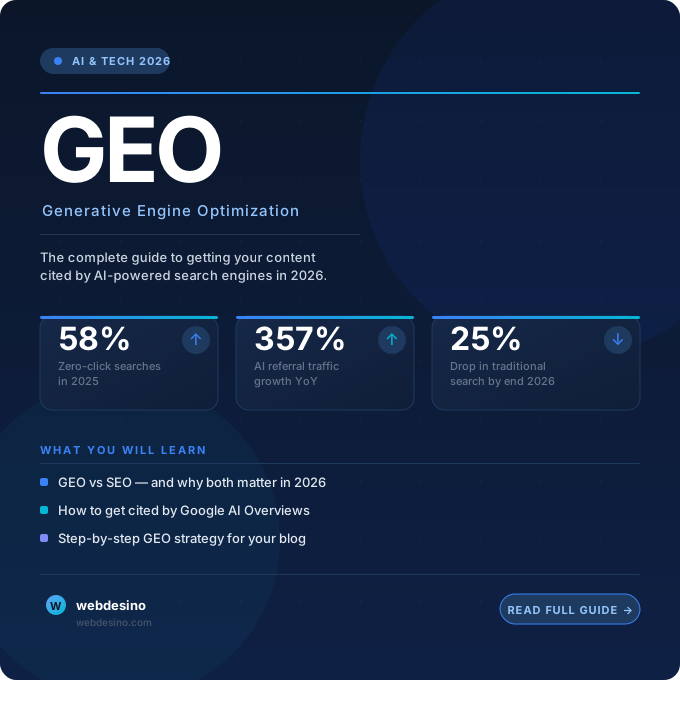
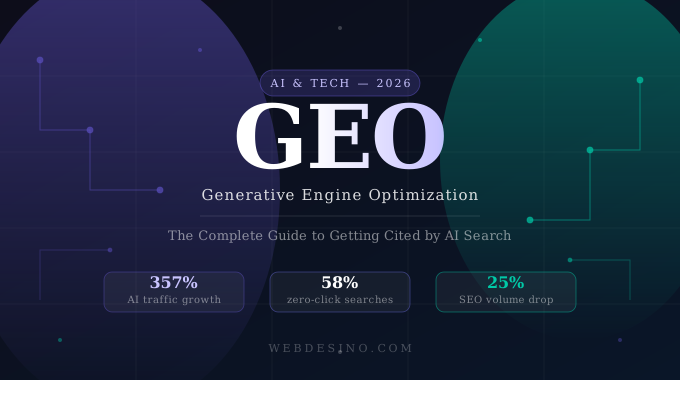
Over 58% of Google searches in 2025 ended without a single click — users got their answer directly from the AI summary.
Referral traffic from AI platforms like ChatGPT, Perplexity, and Gemini grew by 357% year-over-year between 2024 and 2025.
Gartner predicts that by the end of 2026, traditional search engine volume will drop by 25% as AI chat interfaces take over.
Brands that appear in AI-generated answers see up to 40% higher brand recall compared to those that only appear in organic blue links.
The era of simply ranking on page one is not enough anymore. If your content is not being cited by AI, a growing portion of your potential audience will never see it — even if you technically rank for the keyword.
GEO is not optional. It is the difference between being part of the answer and being invisible in the age of AI search.
GEO vs SEO: What is the Difference?
This is the question everyone is asking. And the honest answer is: they are related but not the same thing.
Factor | Traditional SEO | GEO
Goal | Rank high on a SERP | Get cited inside AI-generated answers
Audience | Search engine crawlers + humans | AI language models + humans
Key signals | Backlinks, keywords, page speed | Authority, clarity, structure, citations
Format focus | Title tags, meta descriptions | Clear definitions, FAQs, facts
Measurement | Rankings, organic traffic | AI citation rate, referral from AI tools
Timeframe | 3–6 months to rank | Faster — AI reads and updates frequently
Content style | Keyword-optimised prose | Direct answers, credible, cited sources
The key insight here? SEO and GEO are not enemies. In fact, a well-optimised SEO strategy is the foundation of a good GEO strategy. The difference is in what you optimise for once the foundation is in place.
How Does Generative Engine Optimization Actually Work?
AI search engines like Google's AI Overviews, Perplexity, and ChatGPT do not rank pages the same way traditional search engines do. They read content, evaluate it for credibility and clarity, and then synthesise an answer from multiple trusted sources.
Your job with GEO is to make your content easy for the AI to read, trust, and quote. Here is how that breaks down:
Answer Questions Directly and Early
AI models are trained to find the clearest, most direct answer to a query. If someone searches "what is GEO in marketing", the AI looks for a source that answers that question in the first two to three sentences — not buried in paragraph ten.
Rule: Put your core answer in the first 100 words. Then elaborate. Do not make the AI dig for it.
Use Clear Definitions and Structured Language
AI Overviews love definitions. They love sentences that begin with "[Term] is..." or "[Term] refers to...". This is not dumbing down your content. This is speaking the AI's language.
Whenever you introduce a new concept, define it cleanly and immediately. Think of it as writing for someone who has never heard the term before — because the AI is essentially pattern-matching against millions of such questions.
Structure Content with Proper Heading Hierarchy
AI crawlers — just like traditional search bots — use your heading structure (H1, H2, H3) to understand what your page is about and how the topics relate to each other. A well-structured page is a page that gets cited.
One clear H1 that matches the search intent. H2 headings that break the topic into logical sections. H3 headings for sub-topics and specific questions. Never skip heading levels — go H1 to H2 to H3, not H1 straight to H3.
Include an FAQ Section
This is one of the most powerful GEO tactics available right now. AI Overviews routinely pull from FAQ sections because they are already formatted as question-and-answer pairs — exactly what the AI needs.
At the end of every long-form blog post, add five to ten FAQs that cover the common questions around your topic. Write them naturally, as if a real person is asking.
Cite Real Data and Authoritative Sources
AI models are trained to favour content that cites credible sources — research papers, government data, reputable studies. When you back up your claims with real numbers and link to authoritative sources, you build the kind of credibility that gets you cited.
Do not just say "studies show". Say "according to a 2025 Stanford report" and link to it.
Build E-E-A-T Signals
Google's framework of Experience, Expertise, Authoritativeness, and Trustworthiness (E-E-A-T) is now more important than ever — not just for SEO but for GEO. AI models are more likely to cite sources that demonstrate real human expertise.
Add a clear author bio with credentials. Include a publication date and a "last updated" date. Link to your own research or original data. Get mentioned on other authoritative sites in your niche.
A Practical GEO Strategy for Your Blog in 2026
Knowing the theory is one thing. Here is a practical, step-by-step approach you can apply to every blog post you publish:
Step 1: Start with Search Intent, Not Just Keywords
Before you write a single word, ask yourself: what exact question is the reader trying to answer? Not what keywords do I want to rank for — what is the underlying question? Your entire article should be built around answering that question as clearly and completely as possible.
Step 2: Write Your Definition in the First Paragraph
Every AI-optimised article should have a clear, one to two sentence definition of the core topic in the opening paragraph. This is the single most important GEO signal you can give. If Google's AI Overview is going to quote anyone on "what is GEO", make it you.
Step 3: Use the Inverted Pyramid Structure
Journalists use this: start with the most important information, then add context, then add background detail. AI models read the same way — they weight the top of your content more heavily. Do not save your best insight for the conclusion.
Step 4: Format for Scannability
Short paragraphs. Bullet points for lists. Bold key terms. Tables for comparisons. These are not just reader-friendly — they are AI-friendly. A dense wall of text is harder for an AI to parse and quote accurately.
Step 5: Add Statistics with Sources
Every major claim should have a number and a source. "Referral traffic from AI platforms grew 357% in 2025" is more citable than "AI platforms are sending more traffic". Specific beats vague every single time.
Step 6: Publish FAQs at the End of Every Post
Make this a non-negotiable habit. Five to eight FAQs at the end of each article gives you multiple additional chances to be cited. Each FAQ is essentially a mini-article that the AI can independently pull from.
Step 7: Keep Your Content Fresh
AI search tools favour recent, updated content. Add a "last updated" date to every post. Revisit your top articles every three to six months and update statistics, add new context, and remove outdated information.
Common GEO Mistakes to Avoid
Most content creators make at least a few of these. Fixing them can dramatically improve your AI citation rate.
Writing for humans only and ignoring how AI parses content — both need to work together.
Burying your main answer deep in the article — AI models look for it early.
Using vague claims without data — specificity is currency in GEO.
Ignoring technical SEO — if your page loads slowly or has crawl errors, AI bots may skip it entirely.
Copying competitor content — AI models are sophisticated enough to recognise non-original content and deprioritise it.
Skipping schema markup — structured data like FAQ schema and Article schema directly helps AI understand your content.
Not updating old content — stale information gets replaced by newer, more accurate sources in AI citations.
Useful GEO Tools for 2026
These tools can help you audit your content's GEO readiness and track how often you are being cited by AI platforms:
Perplexity AI — search your own topics and see who gets cited. That tells you exactly where your competition is winning.
Google Search Console — monitor which queries bring impressions and clicks. A widening gap between impressions and clicks may signal AI is answering instead.
Semrush and Ahrefs — both now offer AI visibility tracking features as of 2026.
ChatGPT and Gemini — manually test your target questions. Does your site get mentioned? That is your GEO audit.
Schema Markup Validator (schema.org) — ensure your structured data is correctly implemented.
Quick GEO Wins You Can Implement Today
You do not need to rebuild your entire content strategy from scratch. Start here:
Go to your top 5 blog posts and add a clear definition in the first paragraph if one is missing.
Add an FAQ section (minimum 5 questions) to each of those posts.
Implement FAQ schema markup on those pages using a plugin or manual JSON-LD code.
Add or update statistics with proper source links in your most important articles.
Ensure every article has a visible author name, a publication date, and a "last updated" date.
These five changes alone can meaningfully improve how AI engines read and cite your content — and you can do them this week.
Frequently Asked Questions About GEO
What does GEO stand for in digital marketing?
GEO stands for Generative Engine Optimization. It refers to the practice of optimizing website content so that AI-powered search engines like Google AI Overviews, ChatGPT Search, and Perplexity AI select and cite it in their generated responses.
Is GEO the same as SEO?
No, GEO and SEO are not the same, but they are closely related. SEO focuses on ranking in traditional search engine results pages. GEO focuses on being cited inside AI-generated answers. In 2026, you need both — but GEO is rapidly becoming the more important of the two for top-of-funnel visibility.
How do I optimize my content for Google AI Overviews?
To optimize for Google AI Overviews: write clear definitions early in your content, use proper heading structure, include FAQ sections, cite authoritative data sources, build E-E-A-T signals (author credentials, publication dates, external mentions), and implement structured data markup like FAQ schema.
Does traditional SEO still matter in 2026?
Yes, traditional SEO still matters significantly. Strong technical SEO — fast page speeds, clean site architecture, quality backlinks — is actually the foundation of good GEO. AI crawlers cannot cite content they cannot access or trust. SEO gets you discovered; GEO gets you cited.
How long does GEO take to show results?
GEO can show results faster than traditional SEO because AI models update their citation pools more frequently than search rankings change. Some sites report being cited by AI tools within weeks of implementing GEO best practices, though building consistent AI visibility typically takes two to four months of sustained effort.
What types of content get cited by AI the most?
AI engines most frequently cite comprehensive guides with clear definitions, content with specific statistics and sourced data, FAQ-formatted content, authoritative explainers from established domains, and content that directly answers a specific question in the first two to three paragraphs.
Is GEO relevant for small blogs and niche websites?
Absolutely. Small niche blogs have a significant advantage in GEO because they can become the most authoritative, specific source on a narrow topic — exactly what AI models look for. A niche AI tech blog that deeply covers generative engine optimization has a strong chance of being cited over a large general publication that only briefly mentions it.
What is the difference between GEO and Answer Engine Optimization (AEO)?
Answer Engine Optimization (AEO) was an earlier term used to describe optimizing for voice search and featured snippets. GEO is the more current, comprehensive term that specifically addresses optimizing for AI language model-powered search engines. GEO is broader and more technically involved than AEO.
Final Thoughts: GEO is the New SEO
Here is the honest bottom line. The way people find information online is changing faster right now than at any point since Google launched. AI-powered search is not a future trend — it is the present reality for hundreds of millions of users worldwide.
GEO is not complicated. It is mostly about going back to writing basics: clear answers, honest expertise, well-structured content, and real evidence. The difference is that now, your reader is also an AI model deciding whether to quote you to millions of people.
Start with the quick wins in this guide. Update your top five articles this week. Add FAQ sections. Make your definitions clear. Build your author credibility. Do that consistently, and you will be ahead of 90% of bloggers and businesses who are still only thinking about traditional SEO.
The writers who figure out GEO in 2026 will own the next decade of online visibility. Make sure your blog is one of them.